

The best STEM activities for 5-year-olds are short, hands-on and built around a question your child genuinely wants to answer, such as “Will it float?” or “How tall can we build?” Simple experiments with water, ramps, blocks and patterns teach science, technology, engineering and math through play, with no screens or special equipment required.
The ThomsonKids.com Editorial Team chose the ideas below because they are quick to set up, use materials most homes already have, and are easy to make harder or easier.
Key Takeaways
- At five, STEM is about asking questions, predicting and testing, not memorizing facts.
- Everyday items like cups, tape, water and cardboard make excellent STEM materials.
- Keep activities short and let your child lead the experimenting.
- Talk through predictions: “What do you think will happen?” builds scientific thinking.
- Supervise water play and small parts, and keep materials age-appropriate.
Why Age Five Is a Great Time for STEM
Five-year-olds ask “why” constantly. They are developing longer attention spans, stronger hand control and the ability to compare, sort and count. That makes this age ideal for simple investigations. Typical milestones around this stage, such as counting ten or more objects and copying simple shapes, are outlined in the American Academy of Pediatrics’ developmental milestones for 4- to 5-year-olds.
STEM at this stage is not about getting the right answer. It is about the process: wondering, guessing, trying, noticing what happened and trying again. These habits form the foundation of later learning in every subject.
Science Activities
Sink or Float Challenge
Fill a tub with water and gather a handful of household objects: a spoon, a cork, a leaf, a toy car, a sponge. Before each test, ask your child to predict whether it will sink or float. Sort the results into two piles and talk about what the floaters have in common. Stay within arm’s reach during any water play, and empty the tub as soon as you finish.
Color Mixing Lab
Put a few drops of food coloring in cups of water and give your child a pipette or spoon. Let them mix primary colors to discover new ones. Cover the table first, because food coloring can stain. This teaches cause and effect and is a natural introduction to recording results with simple drawings.
Nature Scavenger Hunt
Head outside with a list of things to find: something rough, something smooth, three kinds of leaves, a rock bigger than your hand. Back home, compare and sort the collection. Observation is the heart of science.
Engineering Activities
Build the Tallest Tower
Offer paper cups, blocks or cardboard tubes and challenge your child to build the tallest freestanding tower. When it falls, ask why. A wider base? Lighter pieces on top? This is the engineering design cycle in miniature.
Ramp Races
Lean a board or a large book against the sofa to make a ramp. Race toy cars, balls and spools. Change the height of the ramp and see what happens to speed and distance. Measuring with footsteps or a ruler adds a math element.
Bridge for a Toy
Ask your child to build a bridge between two stacks of books using only paper, tape and craft sticks. Test it with small toys. Folding paper into a zigzag makes it surprisingly strong, which is always a delightful discovery.
Math Activities
- Pattern trains: Use colored blocks or beads to build repeating patterns, then ask your child to continue or create one.
- Kitchen measuring: Let them scoop and pour rice or water to compare which container holds more.
- Shape hunt: Find circles, squares and triangles around the house and count how many of each.
- Snack sorting: Sort a handful of mixed snacks by color or shape and make a simple tally.
Technology and Early Coding, Without Screens
Technology at this age means understanding tools and sequences. Unplugged coding games are perfect. Draw a grid with chalk or tape and give “commands” like forward, forward, turn right. Then swap roles and let your child program you.
Sequencing cards, simple marble runs and gear sets also build the step-by-step logic behind coding. That visible cause and effect is exactly what we build into the screen-free STEM toys from ThomsonKids.com: mechanisms children can see, touch and adjust.
Activity Planner at a Glance
| Activity | STEM Area | Skills Built | Materials |
|---|---|---|---|
| Sink or float | Science | Predicting, sorting, observing | Tub of water, household objects |
| Tallest tower | Engineering | Balance, planning, persistence | Cups, blocks or tubes |
| Ramp races | Engineering and math | Measuring, comparing, cause and effect | Board, toy cars, ruler |
| Pattern trains | Math | Pattern recognition, sequencing | Blocks or beads |
| Floor-grid coding | Technology | Sequencing, directional language | Tape or chalk |
Tips for Making STEM Time a Success
- Keep it short. Fifteen to twenty minutes is plenty. Stop while your child is still interested.
- Ask, do not tell. Questions like “What could we change?” encourage thinking.
- Celebrate failures. A collapsed tower is data, not a disaster.
- Repeat favorites. Doing an experiment again helps children notice more each time.
- Stay safe. Supervise water play, keep marbles and other small parts away from younger siblings under three, and choose toys labeled for your child’s age.
Choosing STEM Toys for Five-Year-Olds
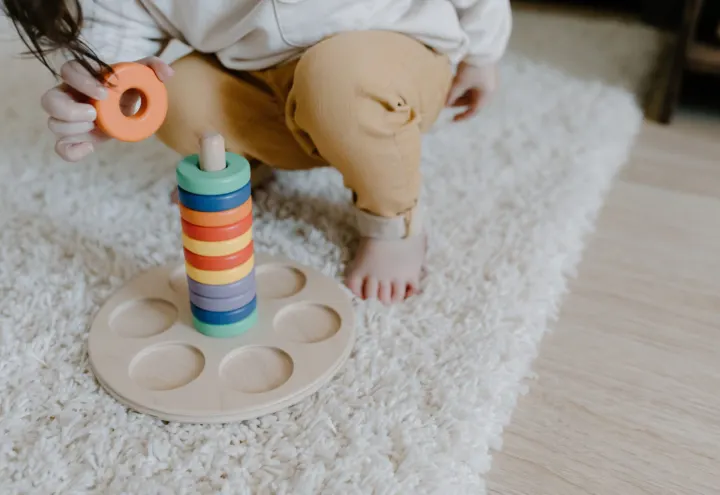
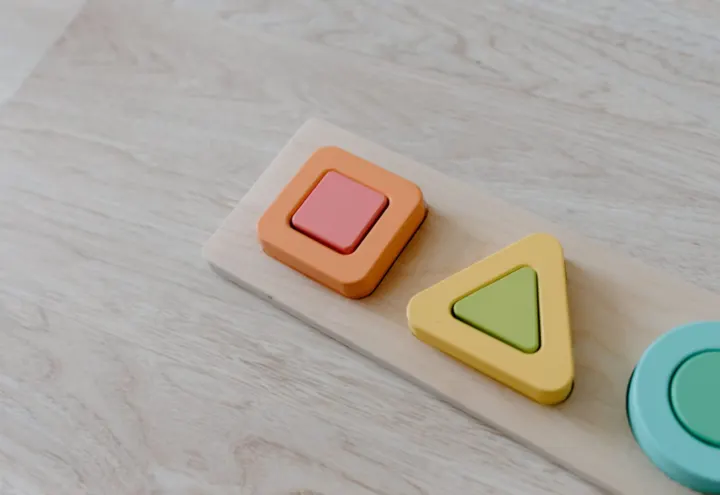
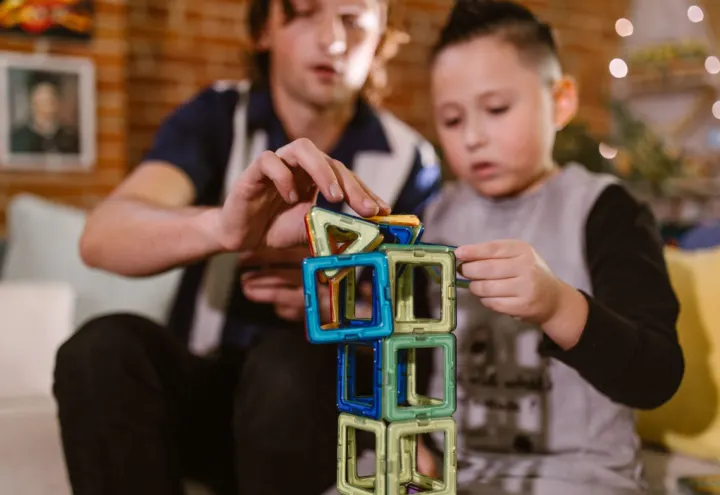
Good STEM toys for this age are open-ended and buildable. Look for construction sets with chunky connectors, gear and marble-run kits, magnetic tiles, balance scales and pattern blocks. These grow with your child and can be used in many different ways. When the ThomsonKids.com team evaluates a STEM toy, the first question is whether a child can use it in more than one way.
To understand what to look for in more detail, read our guide to what STEM toys are and how they build skills, or browse our STEM toys category. Stuck indoors? Several of these experiments also appear in our screen-free rainy day activities, and you will find more hands-on ideas for every age in our learning activities section.
Frequently Asked Questions
What does STEM mean for a 5-year-old?
For a five-year-old, STEM means exploring science, technology, engineering and math through hands-on play. It looks like building towers, testing what floats, sorting objects and following simple sequences. The goal is building curiosity and reasoning skills, not formal lessons or worksheets.
How much time should I spend on STEM activities?
Short, frequent sessions work best. Fifteen to twenty minutes a few times a week is a great rhythm for most five-year-olds. Follow your child’s interest: if they want to keep experimenting, let them, and if attention fades, end on a positive note.
Do I need special kits for STEM at home?
No. Water, cups, tape, cardboard, blocks and kitchen measuring tools cover most early STEM activities. Well-designed STEM toys can add structure and new challenges, but curiosity and a willingness to experiment together matter far more than any kit.
Can STEM activities be done without screens?
Absolutely. Early STEM learning is especially effective without screens because children need to touch, build and test real materials. Unplugged coding games, building challenges and simple experiments develop the same logical, step-by-step thinking that later supports digital skills and confident problem solving.